
What Possible Effects New Hardware and Software May Have on Education
- Mar 24, 2023
- 5 min read
Hardware is a complex topic in the field of corporate training. The IT department and others must consult with the training department before purchasing any new hardware. Managers in charge of training make changes to their approaches as new pieces of hardware, procedures, and company regulations are implemented. In extremely rare cases, IT departments will invest in training-specific gear. Once upon a time, equipping a classroom with computers, screens, keyboards, mouse, projectors, and networking cables was a breeze. No longer are things easy to navigate.
Not only do your workers often bring their own gadgets to the office, but in today's hyper-connected world, almost everything can serve as an input/output (I/O) device. Events like CES demonstrate the near-future hardware realities and the rising software domination that you may have read about in the news. Software is getting smarter, faster, and given a voice while hardware grows more affordable, smaller, and more powerful. Your employee badge can unlock doors, your credit card has a chip, and your fingerprint can unlock your phone and computer. The Internet and associated software are what make the "things" possible in the Internet of Things.
The software not only controls the tiny hardware components, but also the cloud-based applications that communicate with them. Everything is powered by software. As computer software improves, so do the capabilities of Internet of Things devices. By examining thousands, millions, or even billions of data points, software can now begin to grasp context. Connectivity means that things can share their data with one another or upload it to the cloud, where more powerful computers can interpret it. What information must be "understood" by software is entirely variable. Improving your performance is all about that outcome, which is established by those data points. And that's where it'll have an effect on instruction, knowledge retention, and productivity. So what happens when even the most basic tools get high-tech upgrades?
When Heavy Hammers Are Used on Every Business Nail
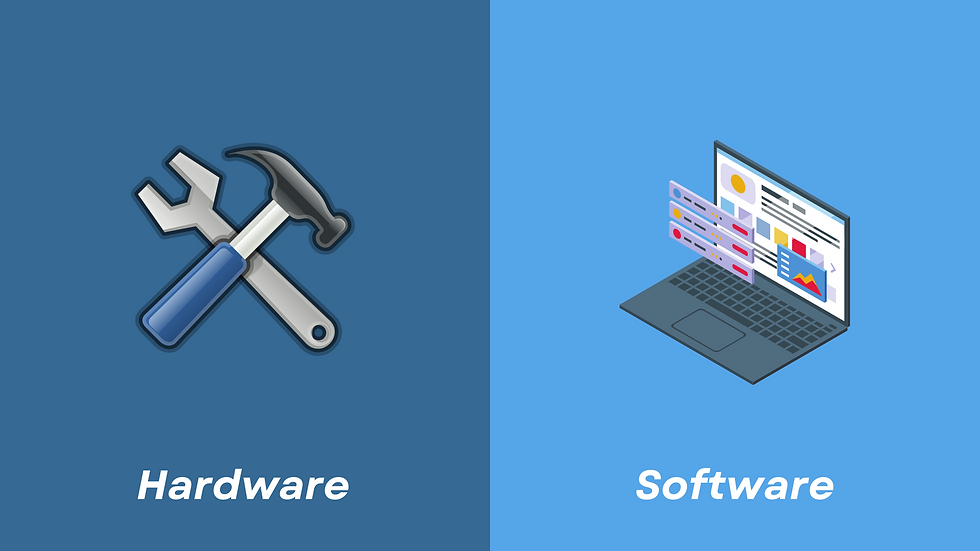
We appreciate the existence of every technological tool that facilitates our work. However, it is the software on or sent by that gadget that enhances your experience with it. The eLearning equivalent of the old saw "when all you have is a hammer, everything looks like a nail" is a quotation from Abraham Maslow. Many people thought that eLearning experts claimed that technology could fix any training problem. When a well-known saying becomes widely discussed in the workplace, you may be quite confident that it has some kernel of truth.
Let's have a look at the humble hammer up close. It has successfully served its purpose for ages. To those who have never tried it, driving a nail into wood requires more effort than it appears to require when using a hammer. The ideal swing depends on a wide variety of parameters. Each subsequent swing incorporates additional parameters in response to the outcomes of the previous swing. A skilled craftsman can make this task appear simple. Join the youngsters at the local home improvement store's craft session, and you'll quickly discover how challenging this tas
k actually is.
The key to mastering any physical skill is to practice it over and over again. It's the same when you use a hammer to drive a nail. As you train, you'll find that you can modify your pace, strength, angle, etc. in increasingly effective ways. The nail will bend slightly before it is fully driven into the board, but that's the only feedback you'll get for the time being. It takes practice to perfect the art of directing one's hammer stroke such that the nail's head takes direct impact. After some time, it will seem as though you've always been able to effortlessly hammer a nail into a plank of wood. Let's imagine it took six months of weekend after weekend to complete the task. You could definitely reduce that period to three months or less if the hammer could collect data based on your early efforts and provide suggestions on how to improve.
Should Every Gadget Be a Smart Gadget?

Is a smart hammer really necessary? The low cost of nails makes regular practice affordable. But I can tell you from experience that it hurts when the hammer accidentally hits your thumb while you're holding the nail. Once upon a time, we used high-priced technological fixes in training for scenarios that were either too costly or too risky to mimic. Add intelligence to a hammer seems plausible and likely now that the price of a small, simple microchip is not much more than a box of nails.
What about the user interface, though? Perhaps one or two buttons? Imagine if your hammer could hold a conversation with you.
Me: Hammer, how am I doing?
Hammer: How is your thumb? Shall I contact 911 for you?
A data transfer USB port is an example of a technology from the past. But now the hammer is too complicated to use effectively. Let’s not do that.
Instead, I hope we see voice-user interface devices like Amazon’s Alexa handling interactions with our smaller tools.
Me: Alexa, activate my hammer.
Alexa: Your hammer is ready for use. <I begin working on my project and drive a few nails>
Alexa: Aniruddha, you’re doing okay. But I’ve cued up a YouTube video that will improve your use of the hammer which will speed up this project by 25%. Shall I play it on monitor 1 or 2?
No changes are planned for the hammer's classic appearance or use. The only real difference is that sensors and processors are included in the handle and maybe the head, and relay information about its use to Alexa. Alexa is submitting the information to a server in the cloud, where it will be analyzed to find a suitable response. There is no self-correction or other modification in the. No need for a separate keyboard or mouse when using this instead; it merely acts as an input device.
Input devices such as the keyboard and mouse have been standard since the 1980s. One example of the new software technology that is making obsolete older hardware is the voice-user interface (VUI). How will corporate education adapt to the introduction of technologies like Alexa into the workplace? When did you last consider doing that?
In conclusion...
These aren't topics of discussion in industry conferences like ATD Tech-Knowledge and Dev-Learn. The implications of developments in hardware/software and novel interfaces like VUI for training systems fascinate me, and I'd love to hear other people's thoughts on the matter. Is there a problem with cognitive strain while using voice to interact with a computer? Should I care? It's possible that Alexa will go crazy and flood us with information.

To what extent will the shift toward voice-driven or device-driven input affect the role of training experts and the solutions they offer as hardware as we know it becomes obsolete? Basic media like video, audio, and text, in addition to in-person training activities, are on the rise in my opinion. Back-end systems and sophisticated simulations in digital worlds will be the new frontier of interactivity. Moreover, I can't imagine that happening so far in the future.
Comments